
The History of the Garden of Our Lord
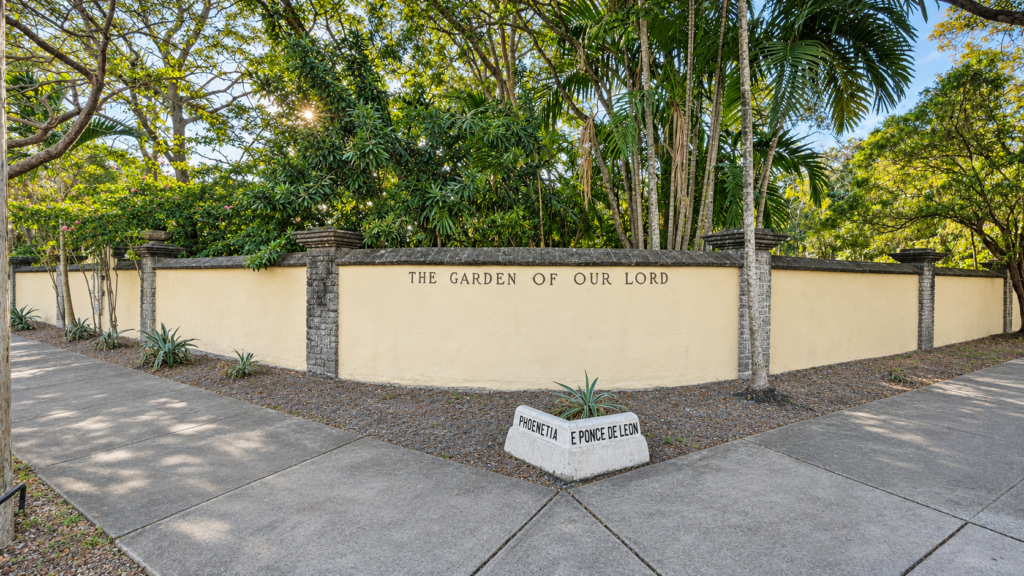
Opened in 1951 beside St. James Evangelical Lutheran Church, the Garden of Our Lord was designed by Coral Gables architect Robert Fitch Smith as a place for prayer, reflection, and quiet enjoyment of nature. Its curved stone wall encloses a landscape of biblical plants, shaded paths, a pool, and a marble statue of Christ.
Over the decades, the garden also became a place of community memory. Its wall bears tributes to local residents, military service members, and Coral Gables founder George Merrick. Together, its design, plantings, and memorials tell a story that has made this small garden a distinctive part of the city for more than 75 years.
St. James and the Garden’s Mid-Century Beginnings
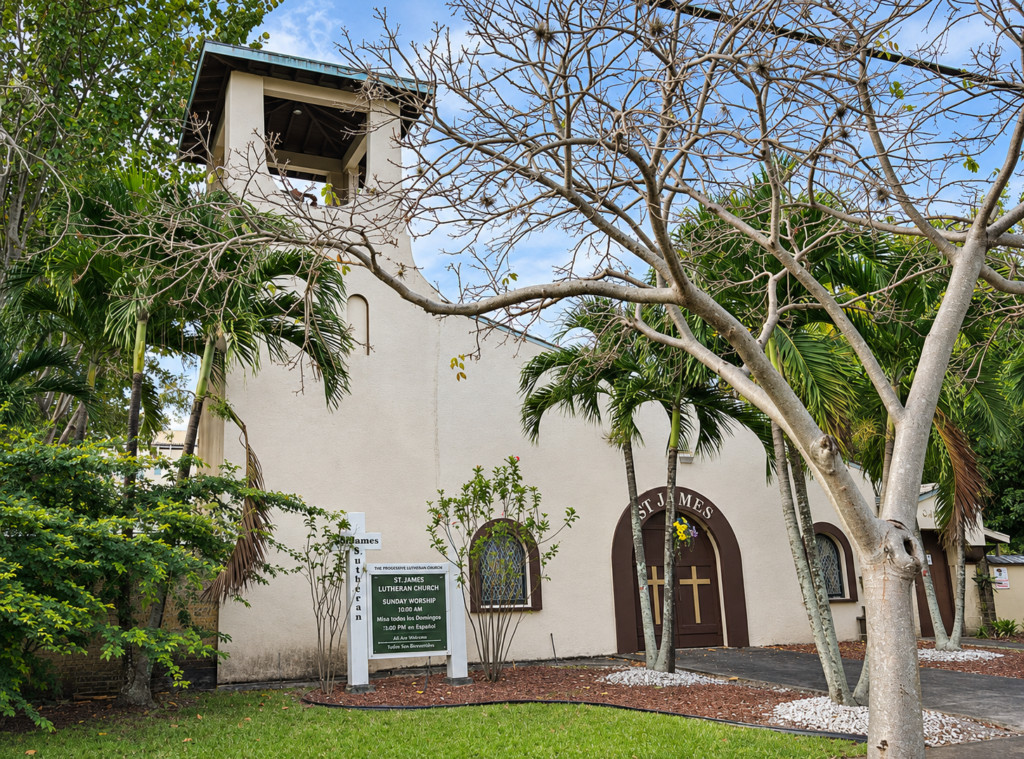
The Garden of Our Lord took shape alongside St. James Evangelical Lutheran Church. The congregation began as a mission in 1945 and moved to the Phoenetia Avenue site in 1947. City records give different dates for the church buildings: a 2023 staff report dates a church building to 1946, while a later neighborhood survey dates the present sanctuary to 1958. The garden’s own date is clearer: it was created in 1951.
The idea came from Colonel Wallace Hackett, a St. James parishioner, and the church’s former minister, the Reverend Theodore Bartus. They envisioned a biblical garden that could offer visitors a place for prayer and reflection. A plaque on the north wall described it as a sanctuary for rest and meditation—a fitting purpose for a garden designed to welcome people into a quiet, living landscape.
Robert Fitch Smith’s Garden and Wall
Robert Fitch Smith was one of South Florida’s most prolific early architects. Born in Ohio in 1894, he came to Miami in 1931 and earned his architecture degree from the University of Miami that year. He also taught architectural design at the university during its early years. A Coral Gables architectural survey credits him with more than 600 residences and hundreds of civic, commercial, and industrial buildings across South Florida and the Caribbean. His work ranged from the rustic Doc Thomas House and the Montgomery Library at Fairchild Tropical Garden to Coral Gables homes and churches.
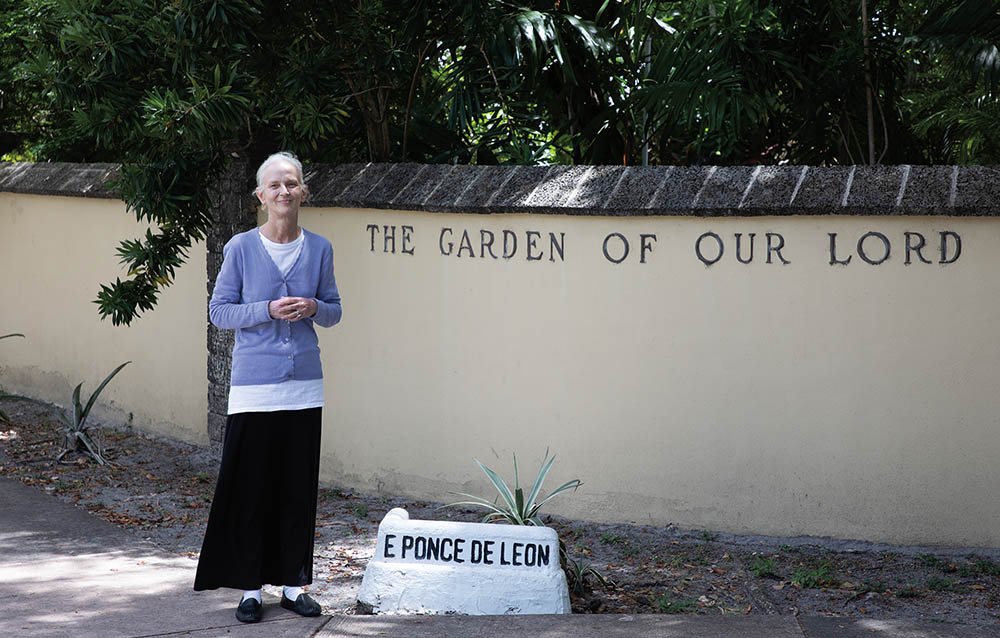
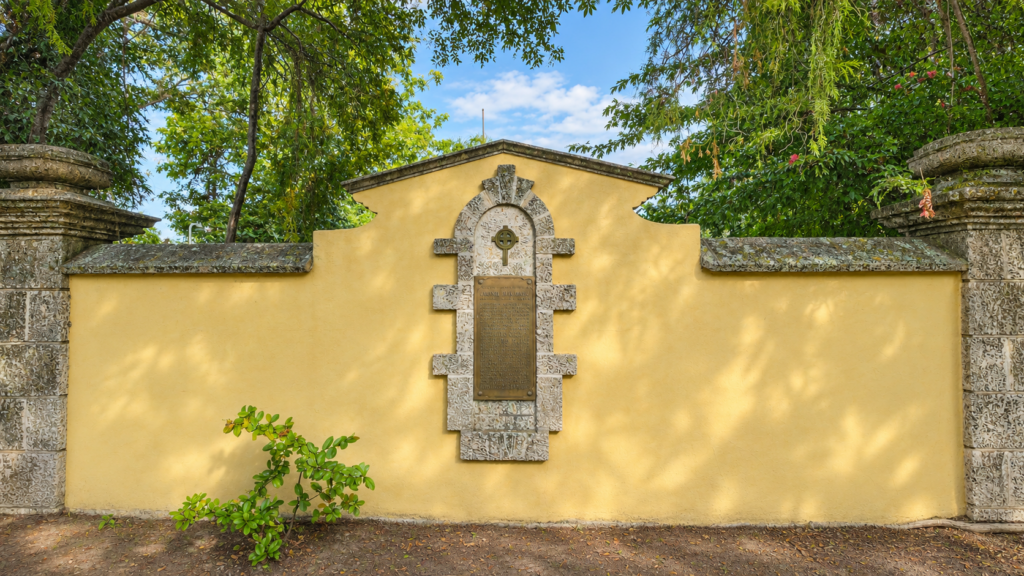
Smith designed its enclosing wall in Florida keystone and coral rock, with stucco surfaces and classical details. The result feels rooted in South Florida while giving the garden a distinct entrance and a sense of shelter. Across Phoenetia Avenue, the wall also relates to the Coral Gables Woman’s Club, tying the garden to the architecture around it. The wall framed the garden’s paths and plantings, and later became a place for dedication inscriptions and memorial plaques.
Plants from the Bible, Seeds from Jerusalem
The garden’s plants were chosen to bring biblical stories into the landscape. A 1974 account described fig, frankincense, myrrh, olive, cassia, pomegranate, and henna, along with an apple tree and carob and acacia trees later lost to hurricanes. Their leaves, fruit, and fragrance made the garden a living collection—one visitors could experience as they walked its paths.
Hazel Westby, a University of Miami professor and Coral Gables resident, brought seeds back from Jerusalem’s Garden of Gethsemane in the early 1950s. She was teaching at the American University of Beirut while on leave from the University of Miami. Many trees still growing in the garden were raised from those seeds, bringing a small piece of Jerusalem’s Garden of Gethsemane to Coral Gables.
A Marble Christ and a Place to Reflect
The garden’s focal point is a white marble statue of Christ, set above a pool at the head of a coral-rock grotto. The garden committee commissioned sculptor Bernhard Zuckerman to carve it from Carrara marble. In testimony to the city, preservation advocates said the marble block weighed nearly eight tons before carving; a later account dates the statue’s unveiling to 1953.
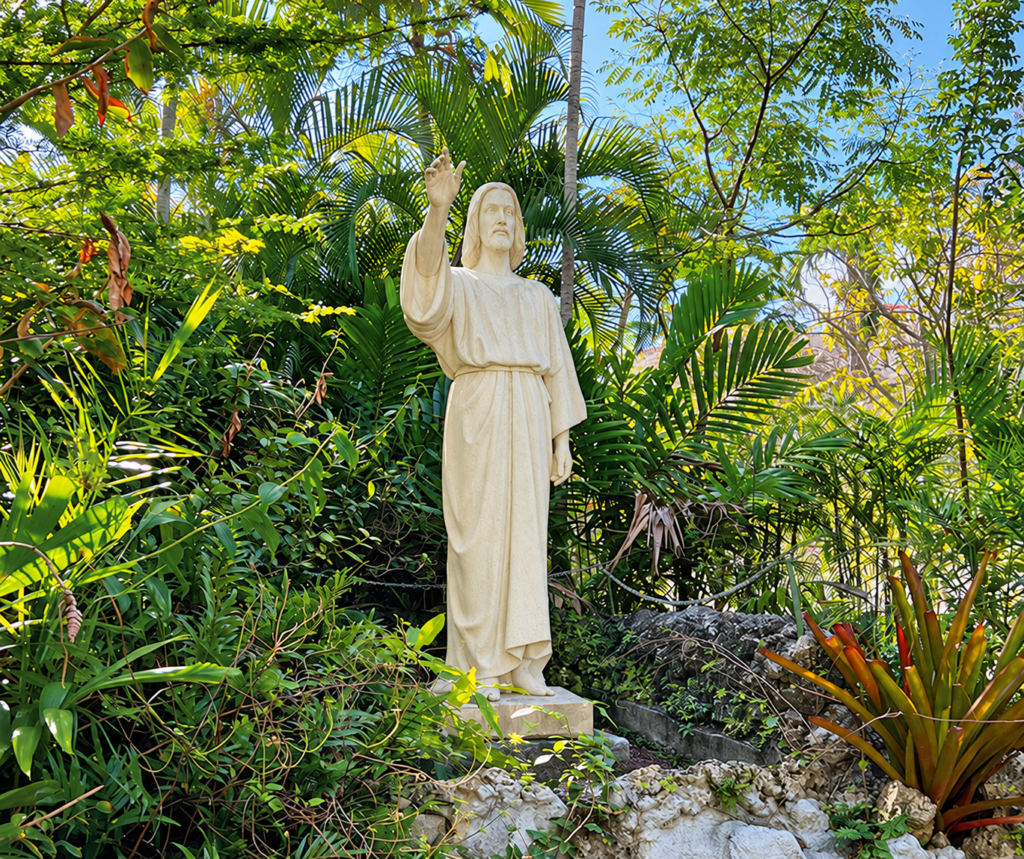
The statue was part of a larger setting for quiet reflection. A 1974 newspaper feature describes stone benches among the fig, frankincense, and myrrh, an altar in the garden’s northwest corner, and a pool where bullfrogs lived. Markers beside the trees explained their biblical connections, giving visitors a reason to pause and learn as they walked the paths. The garden offered several simple places to stop, each with its own view and purpose.
Visitors, Weddings, and a Welcoming Garden
The Garden of Our Lord was open to people beyond the congregation. A 1974 Miami Herald feature reported that visitors came from around the world. It also offered a glimpse of caretaker Albert Hirming’s daily routine among the plants, birds, and his cat. Years later, an entrance sign in English and Spanish invited passersby to pray, meditate, or enjoy the garden.
The garden was also a setting for weddings. A 2022 Herald column describes an arch along the garden path where couples were said to have exchanged vows. That detail shows another side of the garden’s history: alongside prayer and reflection, it held a place in people’s celebrations and family memories.
Stories Preserved on the Garden Wall
The garden wall preserves memories that connect Coral Gables to the wider history of war and service. Its plaques honor Captain William Carbeau Jr., who was killed in World War II in 1944 at age 23. A Coral Gables resident who survived the Bataan Death March. Four chaplains who died aboard the Dorchester. An Army nurse Clara Maass; and city founder George E. Merrick. Together, these tributes gave the garden a lasting role as a place of remembrance as well as prayer.
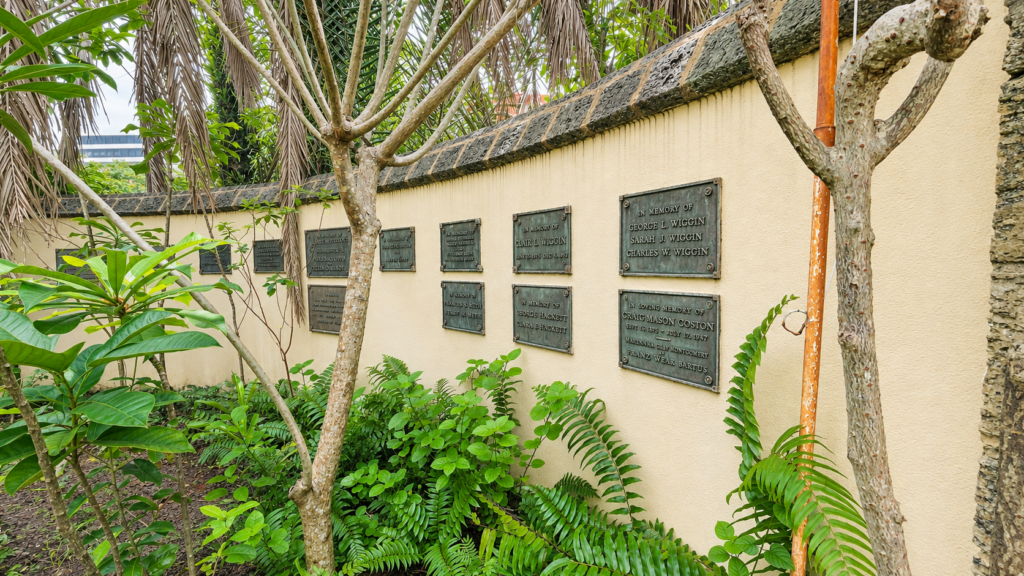
The first memorial began with a father’s grief. William Carbeau, one of the garden’s founders, placed a plaque on the wall in memory of his son. In doing so, he made the garden a place where private loss could be remembered in a setting shared by the congregation and community. Other plaques followed, adding more stories to the wall and deepening the garden’s quiet purpose: to offer people a place to pause, reflect, and remember.
- Garden dedication: A plaque described the garden as a place for rest and meditation.
- Captain William Carbeau Jr.: Placed by his father, William Carbeau, one of the garden’s founders, in memory of his son, who was killed in World War II in 1944 at age 23.
- Bataan Death March survivor: A plaque honored a Coral Gables resident who survived the march.
- The Four Chaplains: A plaque honored the Rev. George L. Fox, Rabbi Alexander D. Goode, the Rev. Clark V. Poling, and the Rev. John P. Washington, who died when the Dorchester was torpedoed in 1943 after giving their life jackets to others aboard.
- Clara Maass: A plaque honored the Army nurse and yellow fever research volunteer. Maass died of yellow fever in 1901.
- George E. Merrick: A plaque commemorated Coral Gables’ founder and his role in developing the city.
A Resting Place for Coral Gables Pioneers
The Garden of Our Lord is also a cemetery and a final resting place for several of Coral Gables’ pioneer residents. Their names and individual stories have not been identified, but their presence connects the garden to the people who helped shape the early city. Florida’s Master Site File lists the Garden of Our Lord as a historic cemetery, and a 2026 Coral Gables City Commission discussion cited the state record as identifying five human remains at the site.
Their graves give the garden a quiet significance that its memorial plaques alone cannot convey. The plaques preserve public tributes to people remembered for their service and sacrifice; the cemetery holds the remains of neighbors whose lives were part of Coral Gables’ own history. Among the garden’s trees and paths, remembrance is not only written on the wall—it is rooted in the place itself.
The Landmarks Coral Gables Almost Lost
Coral Gables has faced this choice before. The Biltmore was nearly bulldozed; plans were made to replace Douglas Entrance with a supermarket; and the abandoned Alhambra Water Tower faced demolition. Residents, preservationists, and city leaders fought to save them. Today, all three are cherished landmarks.
The Garden of Our Lord now asks the city to make that choice again. Its architecture, trees, biblical plantings, memorials, and graves are part of the character that makes Coral Gables distinct: a city shaped by beauty, greenery, and history woven into everyday life. Those qualities are not an idea on a sign. They exist in places like this garden.
Once its wall is torn down and its landscape erased, no later change of heart can bring the original garden back. Coral Gables has saved landmarks that earlier generations might have lost. The Garden of Our Lord deserves the same resolve—while it is still here to be saved.